

Information
- Award number: CNS-2319442
- Project period: 10/1/2023 – 9/30/2027
- Principal investigator: Prof. Maria Apostolaki, Prof. Aarti Gupta
- Graduate students: Fengchen Gong, Divya Raghunathan, Anchengcheng Zhou, Dexin Zhang, Constantine Doumanidis, Minhao Jin
Overview
Computer networks are an essential component of the computing infrastructure that drives numerous products and services in modern society. Network monitoring is essential for detecting malicious activities, troubleshooting, and managing the resources of a network. However, accurate monitoring is notoriously expensive or even infeasible, due to hardware limitations. Network operators use sampling, i.e., they monitor the network less frequently to save on resources. However, sampling makes network management more challenging as it can hide important insights or miss certain events. This project will develop innovative technologies to build a software component, namely a Telemetry Imputation Layer (TIL), that will work atop the networking hardware to improve the accuracy of monitoring. TIL has the potential to revolutionize network management, where network operators will have access to monitoring of unprecedented quality, thereby facilitating more secure, reliable, and performant networks. At a high level, TIL is analogous to image super-resolution in which low-resolution images can be turned into high-resolution ones. For images, super-resolution is possible thanks to the correlations among neighboring pixels and the underlying structure of the images. For network monitoring, the imputation is possible due to the existence of physical constraints and of correlations among the monitored time series.
This research involves solving interdisciplinary challenges that require knowledge of systems, networking, machine learning (ML), and formal methods (FM), to facilitate advances in network monitoring. First, this research will develop an ML model that recovers fine-grained monitoring data from coarse-grained measurements, precisely enough to perform known network management tasks. To this end, the research will investigate different ML models and training pipelines to avoid common ML pitfalls such as lack of generality, overfitting, and data scarcity. Next, this research will develop FM techniques and a logic-based model that connects network operations and monitored measurements via constraints. Using this model, the project will provide the means to answer network management queries using fine-grained network data that are consistent with given scenarios and coarse-grained measurements. Finally, this project aims to develop methods that combine the ML and FM techniques for network imputation in order to benefit from both the existence of data and knowledge in the networking domain.
Publications

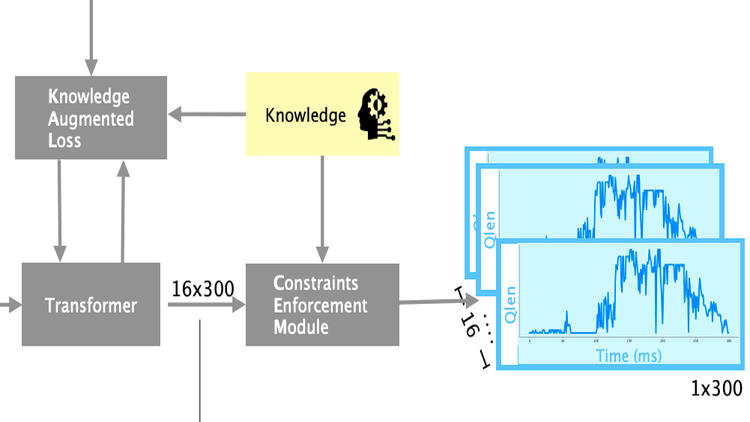
Fengchen Gong, Divya Raghunathan, Aarti Gupta, Maria Apostolaki
ACM HotNets 2023
Paper Slides 3-min Video
Open-source Software
- SIGCOMM '24 Zoom2Net: https://github.com/fchengong/Zoom2Net
- NSDI '25 QUASI: https://github.com/divya-urs/quasi
- USENIX Security '25 PANTS: https://github.com/jinminhao/PANTS
Broader Impacts
- K-12 and Outreach: PI Apostolaki delivered a seminar for high school teachers through TeacherPrep's Teachers as Scholars (TAS) program on how to integrate networking technology and machine learning into STEM education, one of the education activities described in the project proposal, aimed at bringing the material into secondary-school classrooms. TAS is a partnership between Princeton University and several school districts in central New Jersey. Additionally, PI Apostolaki participates each summer as a faculty guest speaker in the AI4ALL program at Princeton that provides accessible AI education for high-school students. Her talks introduce networking concepts and demonstrate how AI can be applied in applications we use every day, such as video streaming.
- Undergraduate Research and Advising: Both PIs participated each summer in the Intel-Princeton Summer REU Program, which is designed to give rising juniors their first experience in research over an 8-week period during the summer at Princeton. Students have a Princeton faculty mentor, an Intel industrial mentor, and a graduate student mentor. PI Apostolaki has also advised several Princeton undergraduate students on topics related to networking, formal methods, and machine learning, including Joshua Lau, Mirabelle Weinbach, and Anya Kalogerakos. Further, PI Apostolaki participates in the B.S.E. first-year advising program organized by the Undergraduate Affairs Office of SEAS at Princeton. PI Apostolaki advises each year 12-15 first-year undergraduate students to provide support on their curriculum and academics and to foster their professional development in engineering.
- Educational Impact: PI Apostolaki developed a new undergraduate course for Fall 2025 on computer networks, that includes modules on the intersection of networks with formal methods and machine learning. PI Gupta developed a new graduate seminar course in Spring 2024 on research advances in automated reasoning with applications in formal verification and synthesis. In this course, students studied recent papers from a variety of application domains -- networks, distributed systems, machine learning, and large language models.